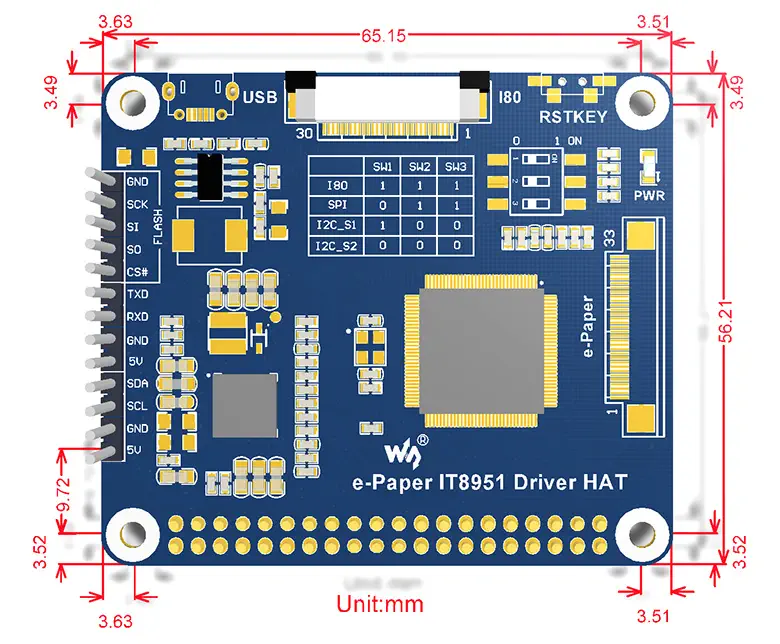
Geschikt voor Raspberry Pi Nul / Nul W / Nul WH / 2B / 3B / 3B +
Omvat niet het Raspberry Pi-bord
De Waveshare 1200x825, 9.7-In E-Ink Scherm HOED voor Raspberry Pi wordt geleverd met een ingesloten besturing IT8951 en communiceert via USB / SPI / I80 / I2C-interface.
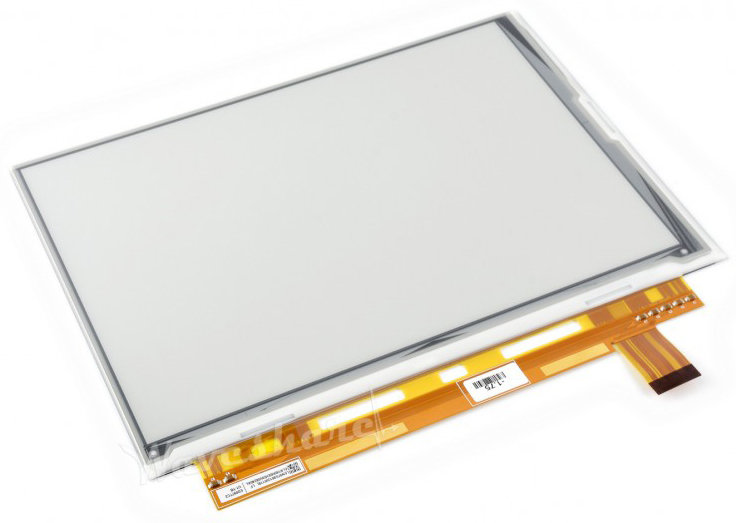
Vanwege de voordelen, zoals een zeer laag stroomverbruik, een brede kijkhoek en een duidelijk scherm zonder elektriciteit, is het een ideale keuze voor toepassingen zoals een planklabel, een industrieel instrument, enzovoort.
C'est tout ce qu'il dit dans la description. L'affichage est vraiment net et l'échelle de gris est agréable. Les images à contraste élevé sont fantastiques. Les images à faible contraste ne sont pas aussi belles, mais ce n'est pas une grande surprise pour une échelle de gris avec 16 nuances. Il contient une image hors tension pendant des jours (plus longtemps, mais je n'ai pas le temps de la tester). Le chapeau se connecte à un Raspberry Pi sans complication. La seule chose qui complique son utilisation est que la pile SW n'est pas très bien expliquée. Mais ça marche. J'ai fini par utiliser Soonuse / epd-library-python sur github. Le suivi des problèmes a un problème de galev00 qui décrit ce qu'il faut pour le faire fonctionner sur Python. À partir de là, vous pouvez afficher n'importe quelle image, en utilisant les fichiers de test comme exemple de la façon d'afficher une image. En python, la bibliothèque d'oreillers peut faciliter le dessin de texte et de lignes sur une image, puis sur l'affichage. En outre, vous pouvez exécuter le chapeau à 80 MHz, au lieu de 24 MHz, ce qui accélère la mise à jour de l'affichage.
E
Erik
Really high quality display
This is everything it says in the description. The display is really sharp and the gray scale is nice. High contrast images look fantasic. Lower contrast images don't look as great, but this is no big surprise for a gray scale with 16 shades. It holds an image with power off for days (longer, but I don't have time to test it). The hat connects to a Raspberry Pi with no complicaion. The one thing that complicates using this is that the SW stack isn't super well explained. But it works. I ended up using soonuse/epd-library-python at github. The issue tracker has an issue by galev00 that oulines what it takes to get it running on Python. From there, you can display any image, using the test files as an example of how to display an image. In python, the pillow library can make it easier to draw text and lines to an image, and then to the display. Also, you can run the hat at 80 MHz, instead of 24 MHz, making the update of the display faster.